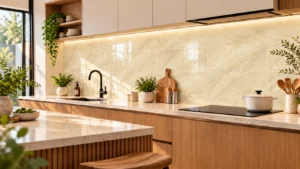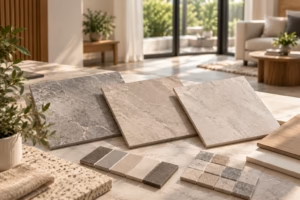
Marble-look porcelain and natural marble both offer a veined, high-end appearance, but they behave differently in daily use and upkeep. Porcelain generally offers more consistent appearance and simpler routine maintenance, while natural marble is valued for its natural variation and unique veining. The right choice usually depends on the project’s budget, maintenance expectations and design intent. As always, check the specifications before you specify.
What Is Marble-Look Porcelain and How Is It Made
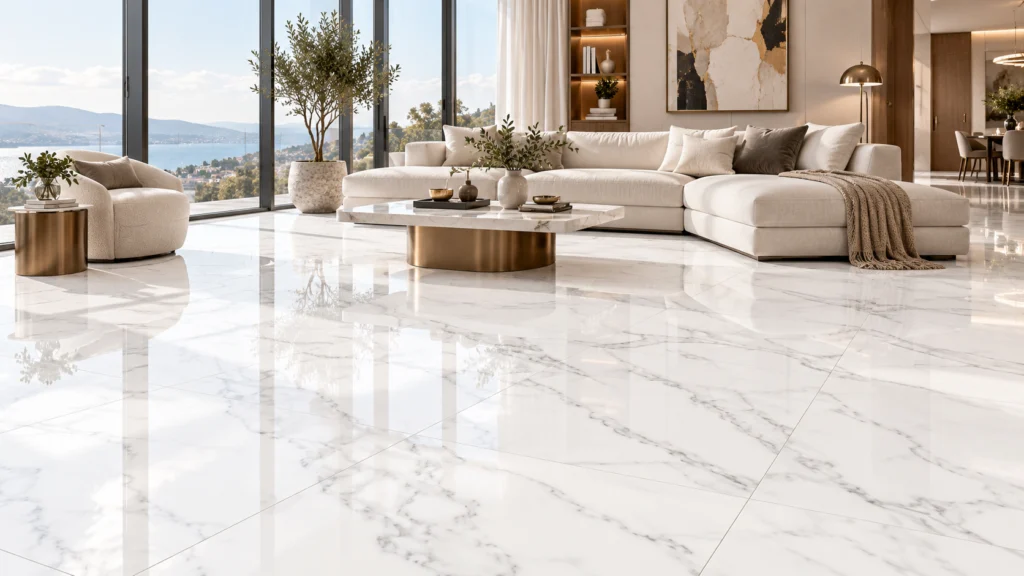
Marble-look porcelain is a manufactured tile designed to reproduce the appearance of natural marble using digital printing and porcelain body technology, rather than being quarried stone. It generally offers a similar visual character to marble while behaving more like standard porcelain tiles in daily use.
- Digital printing. High-resolution digital decoration can reproduce a wide range of marble-inspired veining and colour variations.
- Through-body options. Some marble-look tiles carry colour and pattern further into the tile body, which may make minor chips less visually obvious than on a surface-printed product.
- Vein-matched sets. Certain ranges are produced so that adjoining tiles continue the veining pattern across a floor or wall, intended to mimic a book-matched natural stone look.
- Finish selection. Marble-look porcelain is commonly produced in polished, matte or textured finishes, each affecting how the veining and light reflection read, as covered in the guide to tile finishes.
Natural Marble: A Quick Note on Origins and Character
Natural marble is a metamorphic stone valued for its natural variation, veining and depth. Its history and origins are covered in more detail in The Enduring Allure of Marble. For this comparison, the focus is on how it performs and is specified alongside marble-look porcelain today.
- Natural variation. Natural marble varies in veining and colour because it is a quarried natural stone.
- Porous structure. Marble is generally more porous than porcelain, which affects how it reacts to spills, sealing needs and everyday wear.
- Weight and handling. Natural stone slabs are typically heavier than porcelain tiles of a comparable size, which can affect transport and installation considerations.
- Perceived prestige. Natural marble is often selected for feature applications where its natural variation and material character are part of the design intent.
Names such as Carrara, Calacatta and Statuario are among the most widely recognised marble references, and porcelain ranges are commonly produced in designs that reference these looks, though naming and appearance vary between manufacturers.
Marble-Look Porcelain vs Natural Marble at a Glance
The table below summarises general differences commonly discussed when comparing the two materials. Actual performance varies by specific product and grade, so this is a general reference rather than a fixed rule.
| Factor | Marble-look porcelain | Natural marble |
| Staining resistance | Generally low water absorption | Generally more porous, may need sealing |
| Etching from acidic spills | Generally more resistant to acid-related etching | Can be prone to etching |
| Pattern consistency | Highly consistent across pieces | Naturally variable, unique per slab |
| Typical maintenance | Routine cleaning | Sealing may be required, plus routine cleaning |
| Relative cost positioning | Generally more moderate | Generally higher, project-dependent |
| Repair approach | Tile replacement | Professional repair or restoration may include grinding, polishing or patching |
| Commonly considered for | Floors, walls, wet areas | Feature walls, lobbies, statement floors |
Staining, Sealing and Etching Compared
- Staining. Porcelain generally has low water absorption, while unsealed natural marble may absorb liquids more readily.
- Sealing needs. Natural marble is commonly sealed periodically to help reduce staining risk, while marble-look porcelain typically does not require sealing.
- Etching. Acidic substances such as citrus juice or certain cleaning agents can etch natural marble’s surface, dulling the polish, whereas porcelain is generally more resistant to this reaction.
- Cleaning products. Marble generally requires stone-safe cleaning products, while porcelain cleaning requirements are usually less restrictive.
Cost, Consistency and Long-Term Value
Cost comparisons between marble-look porcelain and natural marble are best considered in relative rather than absolute terms, since pricing varies significantly by grade, origin, size and finish for both materials. Consistency of appearance is a separate but related factor worth weighing.
- Relative cost. Natural marble is often positioned at a higher cost tier than standard marble-look porcelain, although pricing varies by grade, origin, size and finish.
- Batch consistency. Porcelain tiles are typically produced with more consistent colour and pattern across a batch, which can simplify large-area planning.
- Natural uniqueness. Natural marble’s variation is often valued as part of its character, while porcelain offers more controlled visual consistency.
- Long-term value. Long-term value depends on maintenance investment, wear patterns and design longevity, and should be assessed for the specific project rather than assumed from material type alone.
Vein-Matching, Book-Matching and Pattern Continuity
Book-matching refers to arranging adjoining tiles or slabs so their veining mirrors or continues across the joint. Both natural marble and some marble-look porcelain ranges can achieve this, though the process differs.
- Natural stone book-matching. Slabs are typically cut sequentially from the same block and arranged so the veining mirrors across the joint.
- Porcelain vein-matched sets. Some marble-look porcelain collections are designed with pre-planned repeating or mirrored patterns across a set number of tiles.
- Large-format considerations. Larger formats can reduce the number of joints and may make vein continuity more visually apparent. Format and edge precision are covered further in the rectified tiles guide.
- Layout planning. Because vein-matched patterns rely on a specific tile sequence, planning the layout in advance with the installer is generally recommended to avoid mismatched panels.
Repetition across pieces.
Visible repetition of the same veining pattern across multiple tiles, which is part of how a tile looks once installed, generally indicates a printed design with a limited number of face variations rather than natural stone.
Checking the Material.
Check the product data sheet for the relevant specification. It states the material category and is generally the most reliable way to confirm whether a product is porcelain or natural stone.
Repair, Replacement and Everyday Durability
Repair and maintenance requirements differ between the two materials, particularly in high-traffic or long-term projects.
- Scratch and wear marks. Natural marble can show surface wear and dulling over time, particularly in high-traffic areas, and may be re-polished by a professional as part of upkeep.
- Chips and cracks. Porcelain tiles that chip are generally replaced rather than repaired in place, while marble can sometimes be patched or re-honed depending on the damage.
- Colour-through options. Through-body marble-look porcelain may make minor chips less visually obvious compared with a surface-printed tile, since the pattern extends deeper into the body.
- Professional restoration. Marble restoration, such as grinding and re-polishing, is typically carried out by a specialist and is a different process from standard tile maintenance.
Where Each Option Is Commonly Considered
Both materials can be used across residential and commercial projects, depending on the application and product specifications.
- Bathrooms. Marble-look porcelain is commonly considered for bathroom floors and walls where the product specifications suit the application, as discussed further in the bathroom tiles guide.
- Kitchens. Marble-look porcelain is commonly considered for kitchen floors and countertops where spill resistance is a priority, while natural marble is occasionally used for its aesthetic in lower-spill zones.
- Lobbies and feature walls. Both materials are used in lobbies and feature walls, depending on the desired appearance, maintenance requirements and project specification.
- Living and dining areas. Large-format marble-look porcelain floors are frequently considered for open-plan living areas seeking a cohesive, low-maintenance stone appearance.
What to Check on the Product Data Sheet
Before specifying either material, reviewing the manufacturer’s or supplier’s data sheet is generally recommended to confirm the product matches the intended application. Final specifications should be confirmed with the project consultant, safety advisor, installer, or relevant professional.
- Water absorption classification. Check the product’s stated water absorption classification and applicable standard. For porcelain classification, verify the manufacturer’s declared value and applicable standard.
- Surface finish and slip characteristics. Polished marble-look finishes may have different slip characteristics than matte or textured options; the anti-slip tile ratings guide explains how these ratings are generally referenced. These are reference points rather than a substitute for project-specific standards, risk assessment or professional specification.
- Recommended application zones. Confirm whether the product is intended for floor use, wall use, or both, since not all marble-look tiles are rated the same way for each.
- Batch and shade variation notes. Ask whether the supplier notes expected shade or vein variation between production batches, particularly for large orders.
Frequently Asked Questions About Marble Tiles
Can marble-look porcelain be used in a bathroom without extra sealing?
Marble-look porcelain generally does not require the same sealing routine as natural marble, although maintenance remains product-specific.
Does marble-look porcelain feel or sound different underfoot compared with natural marble?
Porcelain and natural marble can differ in feel and sound underfoot, depending on tile thickness, substrate and installation method.
Will marble-look porcelain fade or change colour over time?
Colour stability depends on the product, surface technology and intended conditions of use. Checking the product’s intended use conditions is generally recommended.
Is natural marble suitable for outdoor use in Malaysia’s climate?
Some marble types may be considered for covered outdoor areas, but exposure to rain, humidity and direct sun can affect natural stone differently than porcelain. Suitability should be confirmed against the specific stone type and reviewed with a project professional.
Can I mix marble-look porcelain and natural marble in the same project?
Yes, in many cases the two are combined, such as a porcelain floor paired with a natural marble feature wall or countertop, to balance cost and maintenance with visual impact in specific areas.
How do I know if a marble-look tile will match across a large floor area?
This depends on the range’s vein-matching system and available face variations. Check the layout guidance and review a larger sample before ordering.
Can marble-look porcelain be installed over an existing floor?
This depends on the condition of the existing surface and the specific product’s installation requirements. Overlay installation is possible in some renovation projects, but suitability would be confirmed with the installer or project consultant based on the existing substrate.
Conclusion
Marble-look porcelain and natural marble both deliver a veined, high-end appearance, but they differ in porosity, maintenance needs, consistency and repair approach. Porcelain generally offers more consistent appearance and simpler routine maintenance, while natural marble is valued for its natural variation and material character. The choice depends on the project’s budget, traffic level, maintenance requirements and design intent.
Always check the product data sheet against the intended application before specifying either material.
To review marble-look tile options and their data, browse the Kimgres tile collection, or contact Kimgres for samples and product data.
Note: Tile suitability, durability, and slip resistance may vary depending on project conditions, installation methods, and usage. Final selection should be confirmed with your project consultant or relevant professional.