
Anti-slip tiles are compared using different slip resistance references, including DIN R-ratings and Wet Pendulum P-ratings. DIN R-ratings are mainly used for areas where footwear is worn, while Pendulum ratings are widely used internationally for wet slip resistance assessment. In Malaysia, wet areas such as bathrooms, balconies, car porches, commercial entrances, and pool surroundings may require different tile considerations. As a general guide, P3 to P4 are commonly referenced ranges in industry practice for indoor wet areas. However, these are not regulatory requirements, and suitability depends on project-specific risk assessments, applicable standards, and professional specification.
Why Anti-Slip Tiles Matter in Malaysia
Anti-slip tiles matter in Malaysia because many residential, commercial, and outdoor spaces are regularly exposed to water, humidity, and surface moisture.
In Malaysia, wet surfaces are common due to tropical weather, heavy rainfall, and year-round humidity. Areas such as bathrooms, pool decks, car porches, balconies, outdoor walkways, and commercial entrances may experience regular exposure to water or moisture.
Using tiles with suitable slip resistance can help reduce slip-related risks when properly specified, installed, and maintained. Choosing a suitable tile starts with understanding what slip resistance ratings generally indicate and how they may relate to different project conditions.
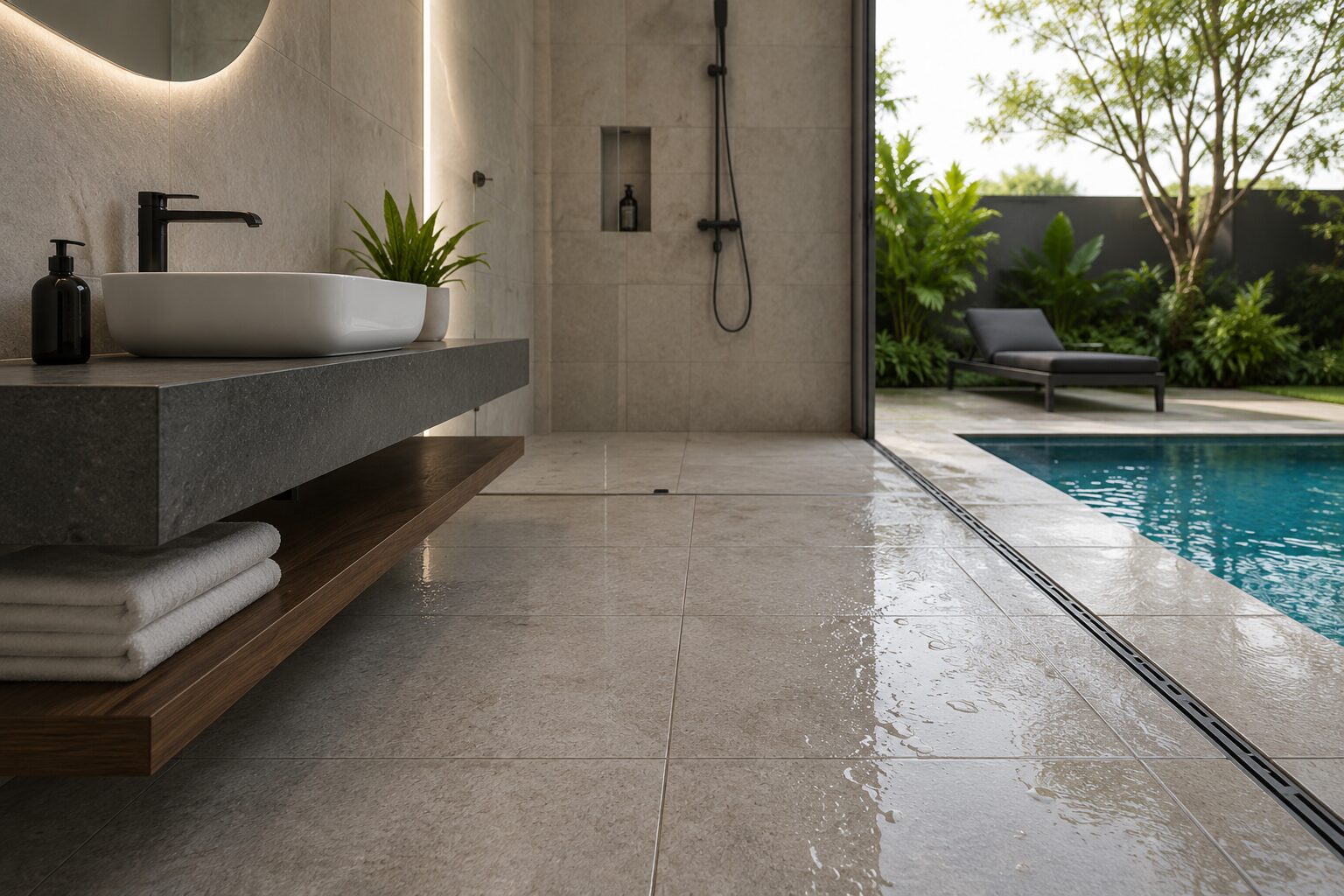
Understanding Anti-Slip Tile Rating Systems
Anti-slip tile rating systems help compare slip resistance, but each rating should be understood according to the test method used.
The R-Rating: DIN 51130 Oil Wet Ramp Test
The DIN 51130 test is commonly used in occupational and industrial environments to access slip resistance in conditions where people wear footwear. The test involves a ramp surface with oil, and the result is expressed as an R-rating, typically ranging from R9 to R13.
As a general guide:
| Rating | General Slip Resistance Level | Common Reference Areas |
| R9 | Lower | Dry indoor areas |
| R10 | Moderate | Light moisture areas |
| R11 | Higher | Outdoor or semi-wet areas where footwear is worn |
| R12 | Very high | Heavy wet, industrial, or more demanding areas |
| R13 | Maximum | Extreme industrial environments |
Because this test uses oil and footwear, it is often more relevant for areas such as commercial kitchens, workshops, food production facilities, or industrial spaces.
R-ratings are developed under footwear and oil-based test conditions and may not represent barefoot wet performance. For barefoot wet areas such as swimming pools, spas, and showers, additional barefoot slip resistance classifications (DIN 51097: A, B, or C) may apply depending on project requirements.
The P-Rating: Wet Pendulum Test
The Wet Pendulum Test is widely used internationally to assess slip resistance under wet conditions. It uses water during testing and gives a Pendulum rating, often from P0 to P5. Pendulum ratings may be expressed differently depending on the applicable standard. (e.g. P-rating classifications or PTV values)
As a general guide:
| Pendulum Rating | General Interpretation | Common Reference Areas |
| P0 | Very low | Not generally used for slip-sensitive areas |
| P1–P2 | Low to moderate | Indoor dry areas |
| P3 | Moderate to good | Indoor wet areas such as bathrooms or kitchens |
| P4–P5 | Higher | Outdoor, commercial wet areas, ramps, pool surrounds, or heavy-traffic wet areas |
Note: Actual tile suitability may vary depending on site conditions, usage, local standards, safety requirements, installation method, and maintenance practices. Final specifications should be confirmed with the project consultant, safety advisor, or relevant professional.
Key Slip Resistance Considerations Across Different Spaces
Different areas of a building are exposed to varying levels of moisture, foot traffic, and surface conditions. Spaces such as bathrooms, pool surrounds, outdoor walkways, and commercial kitchens may present different environmental factors that can influence tile performance. Rather than applying a fixed rating to each space, slip resistance is typically assessed based on a combination of usage conditions, exposure to water or contaminants, and user behaviour.
Wet Indoor Areas (e.g. Bathrooms, Kitchens)
Indoor wet areas are commonly exposed to water, soap, and cleaning residues. In these environments, slip resistance references such as Pendulum ratings are often used as part of the evaluation process.
Factors that may influence tile selection include drainage design, floor gradient, cleaning frequency, and expected user profile.
Barefoot Wet Areas (e.g. Pools, Spas)
Areas with continuous water exposure and barefoot use may require additional consideration beyond standard footwear-based ratings.
In such environments, barefoot slip resistance classifications (such as DIN 51097) may be relevant depending on project requirements and applicable standards.
Outdoor and Semi-Exposed Areas
Outdoor spaces such as balconies, walkways, and car porches are subject to rain, humidity, and surface contaminants.
Slip resistance performance in these areas may be influenced by surface texture, water runoff, exposure to dirt, and long-term maintenance conditions.
Commercial and Industrial Environments
Commercial kitchens, production areas, and similar environments may involve water, oil, grease, and heavy usage.
In these cases, slip resistance assessments may consider test methods that simulate footwear and contaminant exposure, alongside operational requirements such as cleaning regimes and safety protocols.
Porcelain vs Ceramic Tiles in Wet Zones
Porcelain is generally preferred over ceramic in wet-zone applications due to its typically lower water absorption rate and denser body. Depending on the product and manufacturing standard, porcelain tiles often have a water absorption rate below 0.5%.
Lower absorption can contribute to reduced moisture penetration, staining, cracking, biological growth, and changes in surface performance over time. However, actual performance depends on the specific product, surface finish, installation method, maintenance, and usage conditions. Project teams should always check the specific product data, test certificates, and manufacturer’s recommendations before making a final decision.
For surfaces with regular water exposure, porcelain is commonly considered for outdoor areas, pool surrounds, bathrooms, and commercial wet zones. Ceramic may still be suitable for certain applications, especially where moisture exposure is lower and the product is properly selected. Kimgres produces both porcelain and ceramic anti-slip tiles, while porcelain is usually suited to durability-focused applications, and ceramic offering versatility for residential use.
What to Check Before Selecting Anti-Slip Tiles
A stated rating on a brochure or product sheet may not provide the full picture. These are commonly recommended checks before selecting anti-slip tiles for wet-zone or commercial projects.
1. Request the Actual Test Certificate
Ask for slip resistance test certificates where available, not just the product catalogue or marketing material. The certificate should ideally identify the test method, test standard, product name, surface finish, and testing body.
2. Confirm the Certificate Matches the Exact Product
Some tile ranges may include multiple finishes, textures, sizes, or colours. It is important to confirm that the rating applies to the exact product and finish being specified.
3. Understand Which Test Method Applie
Different COF/DCOF standards (e.g. ANSI A326.3) measure slip differently and are not directly interchangeable with DIN or Pendulum ratings. For this reason, test results should be interpreted by qualified professionals where required.
4. Check Manufacturing and Quality Certifications
Tile consistency across batches depends on the manufacturing process, not just the product approval. Kimgres’ Ceramica Indah plant in Kuching and Kim Hin plant in Seremban both hold GreenGuard Gold certification, MS ISO 13006 product certification, MS ISO 9001:2015, and the SIRIM QAS Eco-Label. These certifications cover the manufacturing process itself, providing additional assurance for large or multi-delivery projects.
5. Ask About Batch Consistency for Large Projects
For large developments or multi-phase projects, batch consistency may affect colour, calibre, finish, and installation quality. It is commonly recommended to discuss production batches and delivery planning with the supplier.
Kimgres Slip-Shield: Anti-Slip Performance with Design Appeal
High-rated anti-slip tiles may sometimes use heavier surface textures, which can create a more industrial appearance. This may not always suit hospitality, commercial, or residential interiors where visual finish is also important.
Slip-Shield is Kimgres’ approach to balancing slip resistance with aesthetics. It uses a micro-textured surface designed to enhance surface grip characteristics under certain conditions, particularly in wet or moisture-prone areas, while helping the tile maintain its visual appearance.
The technology is available across multiple Kimgres collections, including the Land Series, which is designed for moisture-prone areas such as poolsides and bathrooms, and suitable for residential and commercial environments. Kimgres describes it as built to withstand humidity, heavy rainfall, and high-traffic conditions in Malaysia when properly installed and maintained.
For project specifications, samples, or supporting documents, speak to the Kimgres team for guidance on suitable anti-slip tile options.
Frequently Asked Questions
What is the minimum anti-slip rating for bathroom tiles in Malaysia?
As a general reference, R10 and P3 to P4 are commonly referenced ranges for bathroom tiles. Residential bathrooms may commonly refer to P3 or similar classifications, while commercial bathrooms or higher-traffic areas may often consider P4.
What is the difference between a DIN R-rating and a Pendulum P-rating?
The DIN 51130 R-rating is tested using oil and footwear, making it more relevant to areas where shoes are worn, such as commercial, industrial, or kitchen environments. The Wet Pendulum Test uses water and is widely used internationally to assess wet slip resistance. Different test methods measure different conditions, so one rating should not be assumed to replace another.
What anti-slip rating do pool tiles in Malaysia need?
P4 to P5 is commonly used as a reference rating for pool surrounds due to frequent water exposure. For barefoot pool zones, barefoot slip resistance classifications may also be relevant, while R-ratings such as R11 are typically referenced for areas where footwear is worn. Actual requirements may vary depending on project conditions.
Why is porcelain commonly used for wet-zone applications?
Porcelain typically has a lower water absorption rate than many standard ceramic tiles, depending on the product and manufacturing standard. Lower absorption can contribute to reduced moisture penetration and may help minimise effects such as staining, cracking, biological growth, and changes in surface performance over time. This is why porcelain is commonly considered for bathrooms, outdoor areas, pool surrounds, and commercial wet zones.
How do I verify an anti-slip rating is genuine?
Request the relevant test certificate from the supplier or manufacturer. Check whether the certificate identifies the exact tile, surface finish, test standard, and testing body. This helps ensure the stated rating applies to the specific product being selected.
Conclusion
Anti-slip tile selection in Malaysia is not just about choosing the highest rating. It is about matching the right slip resistance reference to the right space, whether it is a bathroom, outdoor walkway, commercial kitchen, or pool surround.
As a general guide, the Pendulum P-rating is often used as a key reference for wet zones, with P3 to P4 commonly considered for bathrooms and general wet areas, and higher ratings such as P5 often referenced for pool surrounds or high-risk wet areas. DIN R-ratings remain useful for areas where footwear is worn, especially outdoor, commercial, and industrial environments.
To reduce project risk, verify the stated rating with proper test certificates and ensure the selected tile matches the actual project conditions. For a clearer understanding of anti-slip ratings, wet-zone applications, and suitable tile options, explore the Kimgres anti-slip tile range or contact Kimgres for guidance.